

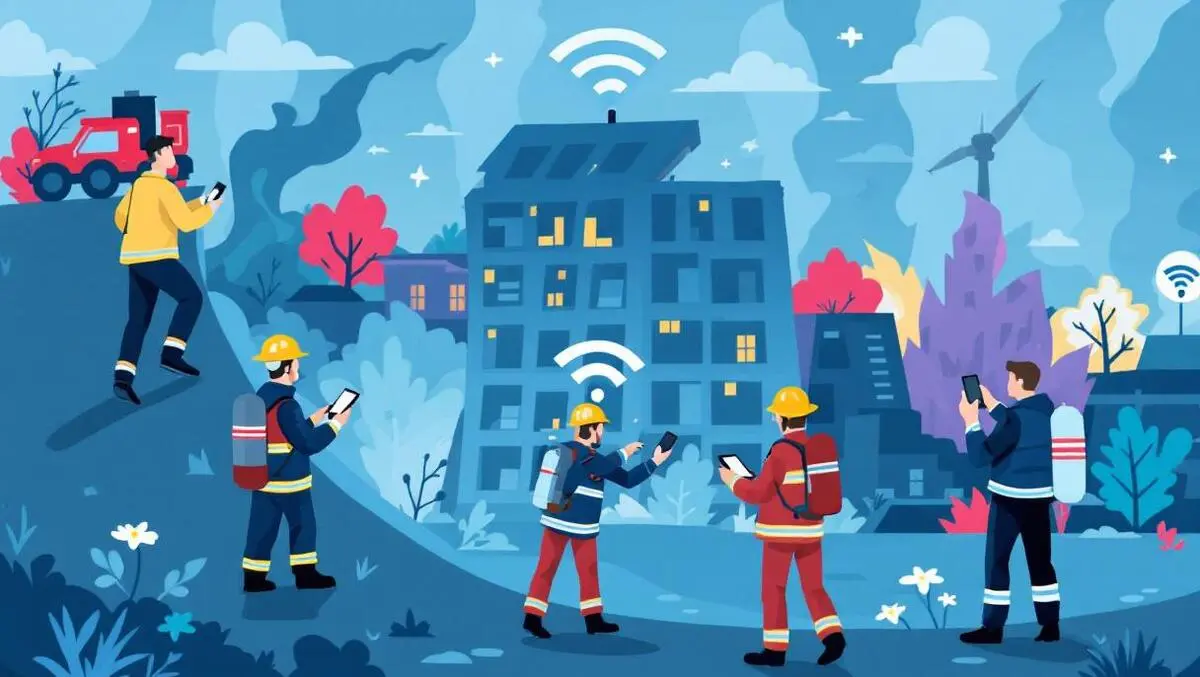
Wi-Fi solutions improve emergency responses & critical calls
Wed, 8th Oct 2025
The Wireless Broadband Alliance has published three reports outlining how Wi-Fi technologies can support emergency calling and priority communications between the public, first responders, and emergency services.
The reports, produced by the Alliance's Mission Critical & Emergency Services Programmeme, set out a framework for leveraging Wi-Fi, Passpoint, and OpenRoaming to sustain essential communications where other methods may fall short-such as indoors, in densely populated areas, or during crises that disrupt cellular networks.
Enhancing emergency communications
Past emergencies, including natural disasters where cell towers have been incapacitated, have already demonstrated the usefulness of Wi-Fi as a backup communications platform. The new reports address not only emergency operations in challenging physical or network environments, but also how Wi-Fi can support public safety and emergency responses where bandwidth, signal coverage, or connection density constrains other solutions.
The documents provide practical guidance for a wide range of stakeholders, including emergency services, public safety organisations, mobile operators, device manufacturers, and Wi-Fi service providers. They examine the role Wi-Fi can play in extending mobile services to improve emergency responsiveness, and in helping mobile operators address coverage issues in buildings and crowded public sites. They also explore how Wi-Fi can enable reliable, two-way communications for emergency personnel during disaster recovery and crowd control operations.
Shared vision and framework
The reports present a shared outlook for deploying Wi-Fi as an integral public safety tool across six principal areas. These include Wi-Fi's evolution into a standards-compliant and resilient infrastructure for emergency services, the capacity to route emergency calls over Wi-Fi irrespective of a user's mobile service status, and the provision of priority access for National Security and Emergency Preparedness (NS/EP) users. Other focus areas include seamless and secure federated network access via OpenRoaming and Passpoint, accurate location delivery for emergency calls, and ensuring alignment with international legal and regulatory standards such as those set by 3GPP, IEEE, and the FCC.
Industry-specific reports
One of the three reports introduces an end-to-end framework for emergency calling over Wi-Fi, designed to enable people without cellular coverage or credentials to place emergency calls while ensuring secure authentication and accurate location identification. This includes credential-free Wi-Fi access that still delivers location-aware calls, with the goal of meeting operational and legal requirements globally and expanding emergency services access to previously unconnected or Wi-Fi only users. There is a recommendation for device manufacturers to incorporate emergency profiles directly into their devices.
A second report targets mobile operators, describing the use of OpenRoaming as a means of extending Voice over Wi-Fi (VoWi-Fi) and emergency calling into areas where mobile signals are weak. This report explains how OpenRoaming can serve as an international emergency fallback for when cellular networks are unavailable, with SIM-based authentication and robust call routing combining to ensure emergency calls remain possible and are correctly localised. OpenRoaming's performance tiers are also evaluated for their ability to deliver the necessary quality of service for high-priority communications.
The third report discusses the requirements of organisations and government agencies with NS/EP responsibilities, for whom robust communications infrastructure is essential during major incidents. It highlights the role that quality of service and resilience on Wi-Fi networks play for emergency services and the increasing dependence on uninterrupted connectivity for IoT devices such as CCTV, access control, and infrastructure monitoring systems.
Industry leaders respond
Tiago Rodrigues, President and CEO of the Wireless Broadband Alliance, said: "Emergency communications must be seamless, secure and dependable-indoors, in dense public spaces and during crises. These reports show how Wi-Fi and OpenRoaming enhance cellular network emergency communications to deliver seamless resilient, standards-based services for the public, first responders and emergency services teams coordinating emergency responses."
Matthew MacPherson, CTO, Wireless at Cisco, commented on the collaborative industry effort to broaden the scope of mission critical services to encompass Wi-Fi:
"Cisco has led the industry effort with WBA members to bring mission critical services such as Emergency Calling and National Security and Emergency Preparedness services to Wi-Fi. These services, long available only on cellular, are now extended to Wi-Fi, making it a platform that supports life-saving and mission critical needs. Citizens, enterprises, and governments can now rely on Wi-Fi alongside cellular when it matters most. Converging Wi-Fi and 5G for emergency services creates a stronger foundation that better serves our communities, our emergency responders, and ultimately all of us."
Josephine Micallef, Vice President of Cyber and Network Systems at Peraton Labs, highlighted the implications for national security communications and stressed the value of Wi-Fi in enabling emerging technologies:
"Wi-Fi is a critical technology for supporting national security and emergency preparedness communications. Our efforts in this area, which were supported by the Emergency Communications Division of the Cybersecurity and Information Security Agency within the U.S. Department of Homeland Security, have been aimed at defining and standardizing the capabilities to allow individuals with NS/EP responsibilities to take advantage of Wi-Fi networks. These reports provide a clear view of how to exploit the priority features in Wi-Fi technologies to enable the ubiquitous, low-latency and high-throughput communications these authorized users need to exploit emerging applications, including artificial intelligence and autonomous systems, when performing their critical duties."
The Wireless Broadband Alliance's new reports are intended to encourage collaboration across the technology and emergency services sectors and set out a clear technical and regulatory model for the use of Wi-Fi in mission critical and emergency scenarios.