

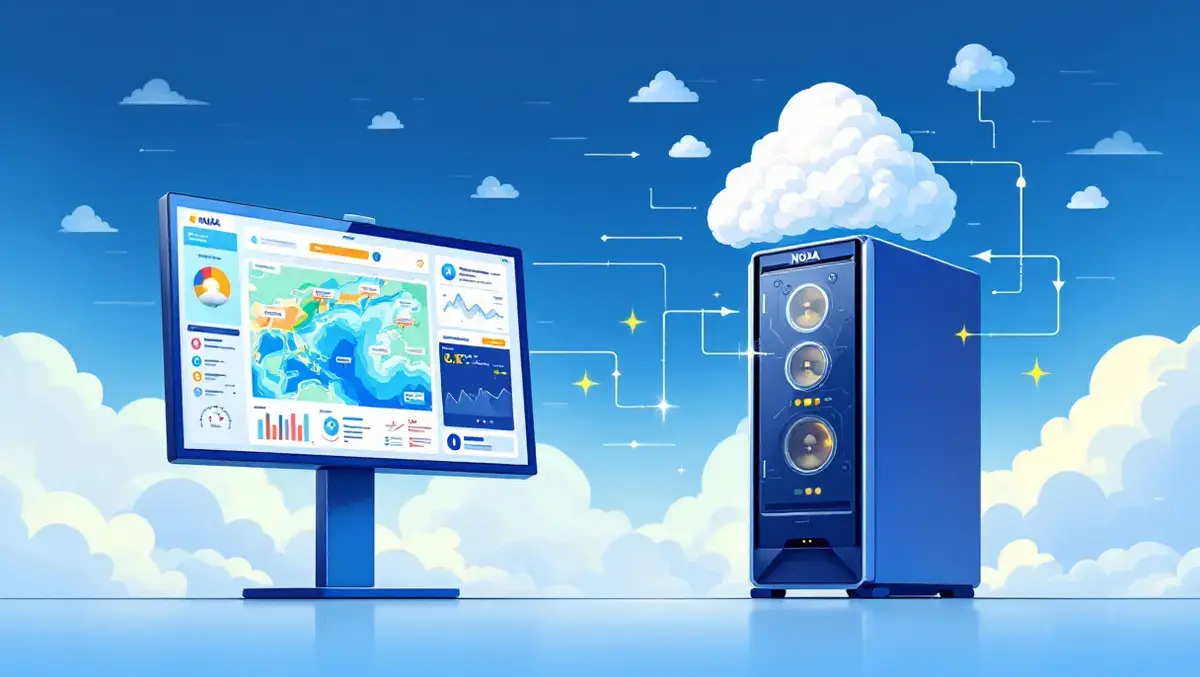
NOAA picks Google Cloud for weather supercomputer shift
Tue, 28th Jul 2026
NOAA has selected Google Cloud as the primary infrastructure provider for its Weather and Climate Operational Supercomputing System, shifting one of the world's operational numerical weather prediction centres towards the public cloud.
The US weather agency is moving a core forecasting system away from traditional on-site computing as it overhauls the technology used to run weather and climate models. Known as WCOSS, the system sits at the centre of NOAA's operational forecasting work and supports simulations used to predict atmospheric conditions.
NOAA will use Google Cloud's H4D virtual machines as the main computing platform for the programme. The systems use fifth-generation AMD EPYC processors and are designed for compute-intensive workloads that require close coordination across large numbers of machines.
That matters for weather forecasting because numerical prediction depends on vast simulations that exchange data quickly across tightly linked computing resources. The shift suggests NOAA wants a more flexible way to expand and adjust its modelling environment without relying solely on fixed on-premises systems.
Cloud shift
The decision marks a notable change for a government body that has historically depended on dedicated supercomputing facilities. It also reflects a broader pattern as public agencies test whether cloud providers can handle workloads once seen as better suited to specialist in-house infrastructure.
NOAA described the move as part of a cloud-first approach. In practice, that means rebuilding a mission-critical forecasting platform around rented computing capacity rather than equipment it owns and operates directly.
The cloud model may give meteorologists and researchers more room to change software, test new methods and adjust computing demand as forecasting models evolve. It could also reduce the delays that often come with procuring and installing new supercomputing hardware through traditional public-sector cycles.
Long relationship
The contract builds on an existing relationship between NOAA and Google. The two have previously worked together on sharing large environmental datasets, tracking wildfires in real time and supporting marine conservation work.
According to Google, NOAA adopted Google Workspace as its collaboration suite in 2011. Earlier cloud-related work inside the agency included a compute accelerator pilot developed by NOAA Fisheries to give scientists access to flexible processing resources when needed.
That history suggests the WCOSS decision did not emerge from a single procurement exercise in isolation. Instead, it appears to reflect years of smaller projects that familiarised parts of the agency with Google's tools and cloud environment.
Forecasting pressure
The computing demands of operational weather prediction have been rising as agencies pursue more detailed models, faster updates and better handling of extreme events. Forecast systems must process large volumes of atmospheric and ocean data while delivering outputs quickly enough to support warnings, aviation, shipping, emergency planning and daily public forecasts.
Modern forecasting also depends on balancing reliability with experimentation. Agencies need stable operational systems for daily use, but they also need room to test new models, data assimilation methods and machine learning tools that may improve forecast skill.
Google pointed to work involving WeatherNext, developed by Google DeepMind and Google Research, in connection with NOAA's hurricane forecasting efforts. The company said the model helped predict Hurricane Melissa's Category 5 landfall in Jamaica five days in advance.
That example underscores how cloud computing, large-scale modelling and newer artificial intelligence systems are beginning to converge in weather science. The operational challenge for agencies such as NOAA will be integrating those approaches into production systems while maintaining trust, speed and resilience.
Strategic importance
For Google Cloud, the selection adds a high-profile public-sector workload in a technically demanding field. Weather prediction has long served as a benchmark for large-scale computing, and success there could strengthen a provider's case for other scientific and government contracts.
For NOAA, the project carries strategic weight because forecast quality has direct implications for public safety and economic planning. Better modelling can shape responses to storms, floods, heatwaves and other hazards affecting households, transport networks, agriculture and energy markets.
The announcement also points to increasing competition among technology suppliers for government contracts tied to science and national infrastructure. Public agencies are under pressure to update ageing systems, but they must also show that outsourced platforms can meet security, reliability and performance requirements.
Google said the arrangement is intended to support NOAA's weather modelling work at scale. It described the partnership as the latest step in a collaboration that already spans data sharing, research support and agency-wide productivity software.
By placing WCOSS on Google Cloud, NOAA is undertaking one of the most significant cloud migrations yet in operational weather forecasting.