

US tops global eSIM readiness index as UK ranks high
Fri, 15th May 2026.webp)
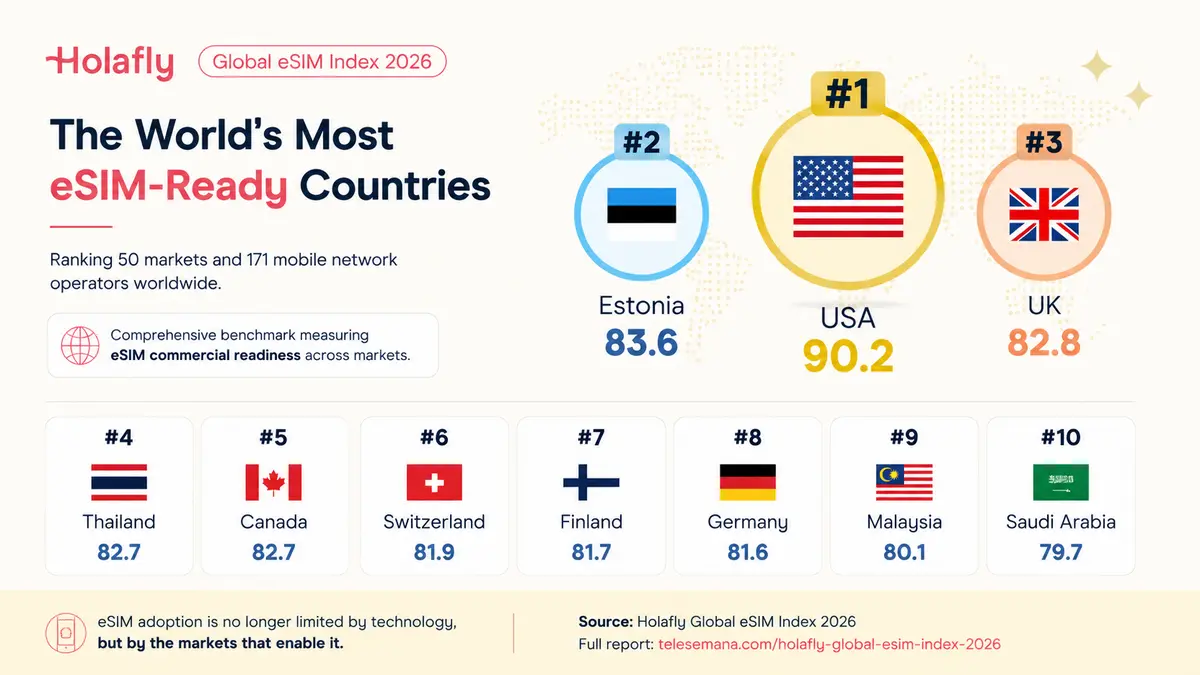
Holafly and TeleSemana.com have launched the Holafly Global eSIM Index 2026, which ranks eSIM readiness across 50 mobile markets.
The index assesses 171 mobile network operators using a scoring system from 0 to 100 to measure commercial readiness for large-scale eSIM adoption. It evaluates market readiness, activation and customer support, adoption and competition, the regulatory environment, and expert assessment.
The United States ranked first with a score of 90.2, followed by Estonia and the United Kingdom. Singapore, Germany and the Netherlands also placed among the highest-ranked markets.
At the bottom were Sudan, Liberia and India. The report attributed their low scores to structural barriers including limited device access, fragmented operator support, restrictive regulation and friction during activation.
The findings suggest the eSIM market is shifting away from technical constraints and toward commercial and policy conditions. The study identified regulation, activation processes and openness to international eSIM providers as the main barriers to wider adoption.
Markets that allow digital onboarding, simpler activation and broader access for international providers are seeing faster adoption. The methodology also includes a regulatory penalty to reflect the effect of restrictions on international eSIM providers, which the study said limit access for travellers and make digital connectivity services harder to scale.
Ranking factors
The framework combines operator-level analysis with country-level indicators and user experience measures. It also considers market accessibility, or how easily consumers can obtain and activate eSIM services.
That approach emphasises the customer journey as much as network conditions. In the study's view, top-performing countries are not only those with strong telecom infrastructure, but also those that reduce friction in activation and onboarding.
Travel eSIM providers were identified as an important driver of change in the wider telecom market. Demand from international travellers for instant mobile access without physical SIM cards, retail activation or conventional roaming arrangements is changing how consumers buy connectivity abroad, according to the study.
Holafly linked that trend to broader shifts in travel behaviour over the past decade. It said connectivity has moved from an optional extra to a routine part of travel, with users relying on mobile data for navigation, payments, transport apps, remote work, communication, trip management and safety services.
That shift is supporting demand for cross-border connectivity models that work across several destinations. The report also pointed to broader trends including the decline of physical SIM distribution, the rise of app-based onboarding and growing demand for digital-first customer experiences.
Industry view
Chris Hills, Vice President of Carriers & Operations at Holafly, said the market had entered a new stage.
"eSIM has already moved beyond being an emerging technology. The next phase of growth will depend on how effectively markets enable seamless digital access for users. The countries leading this transition are not necessarily those with the largest telecom infrastructure, but those creating frictionless experiences that align with the expectations of today's global travelers," Hills said.
The study is presented as a reference point for operators, regulators, investors and technology groups seeking to compare national markets. Its scoring system is designed to show where regulatory structures, operator practices and customer experience are helping or hindering adoption.
In that view, competition in telecom is increasingly shaped by standards set beyond the sector itself. Consumers now assess connectivity products against digital services across the wider economy, not just against rival mobile operators.
"Consumers no longer compare telecom experiences only against other operators. They compare them against the simplicity and immediacy they experience in digital services across every industry. That shift is redefining expectations for mobile connectivity globally," Hills said.